

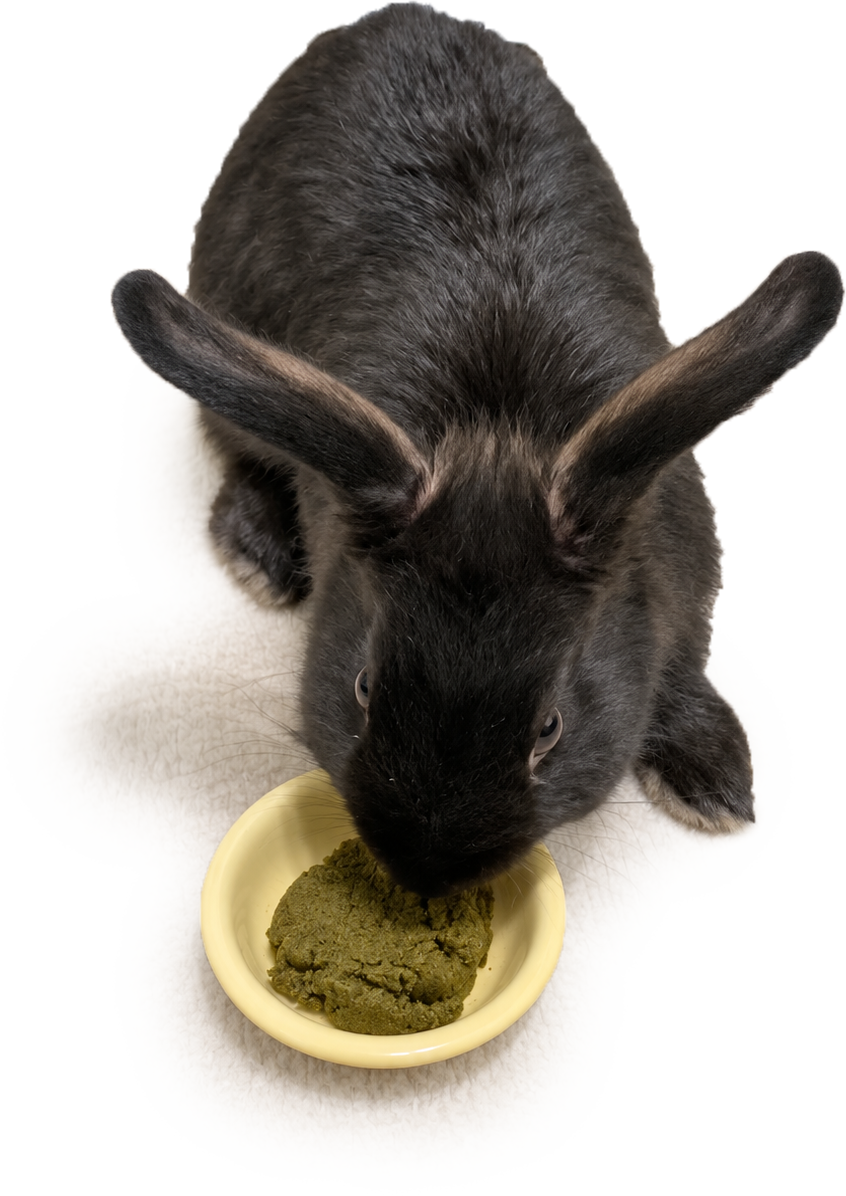
Understand the Ingredients, Fiber Content, and Dietary Proportions Before You Buy
Choosing rabbit pellets should not be based only on the brand, price, or a “high-fiber” claim on the package.
A healthy adult rabbit’s daily diet should center on unlimited grass hay, with pellets making up only a small portion. When choosing pellets, consider their physical form, fiber and protein content, forage ingredients, added ingredients, and intended life stage.
Once you understand that most pellets are made by grinding, blending, and reshaping forage ingredients, it becomes easier to see how a simple-ingredient hay powder can serve as a supplemental way to introduce hay-based flavors. However, hay powder cannot replace staple hay, nor is it automatically equivalent to a nutritionally complete supplemental formula.
Walk into any pet store and you will see rabbit food packages featuring claims such as “high fiber,” “natural forage ingredients,” “complete nutrition,” and “highly palatable.”
They may sound healthy, but once you turn the package over, you are often faced with a long list of unfamiliar ingredients and numbers.
How should you choose rabbit pellets? Is a higher crude fiber percentage always better?
Does seeing hay meal in the ingredient list mean the product is lower quality?
Before comparing any products, establish one important principle:
The role and quality of pellets within a rabbit’s overall diet matter more than the brand.
Grass hay should remain the staple food for a healthy adult rabbit. Pellets should be offered as a small, measured source of concentrated nutrition—not as an all-you-can-eat staple that is constantly refilled.
Look at the overall dietary proportions before looking at the pellet package. The general adult-rabbit feeding model provided by the RSPCA and the Rabbit Welfare Association & Fund (RWAF) is:
| About 85% hay | About 10% safe, washed leafy greens and herbs |
|---|---|
| About 5% pellets | Clean drinking water available at all times |
The 85:10:5 ratio is a way to understand the overall structure of the diet. It does not mean weighing each type of food and feeding them in the same proportions by weight.
Leafy greens contain a large amount of water, while dried hay contains very little, so the two cannot be compared directly by weight.
The appropriate amount will also vary according to a rabbit’s age, weight, activity level, body condition, and health.
Why Should You Look at the Dietary Proportions First?
Even if a pellet has an impressive nutritional analysis, the overall diet may still become unbalanced if the rabbit fills up on pellets and gradually eats less hay.
The Merck Veterinary Manual recommends providing unlimited access to high-quality grass hay, with pellets making up only a smaller portion of the diet. The RWAF also notes that feeding too much commercial rabbit food may reduce hay intake.
How to Choose Rabbit Pellets: Check These Six Things First
1. Choose Uniform Pellets, Not a Mix That Encourages Selective Eating
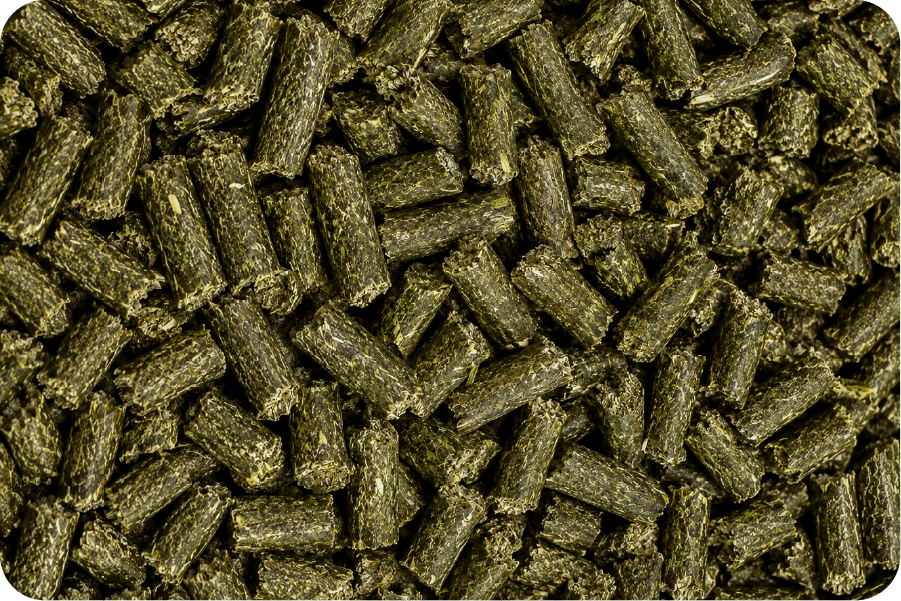
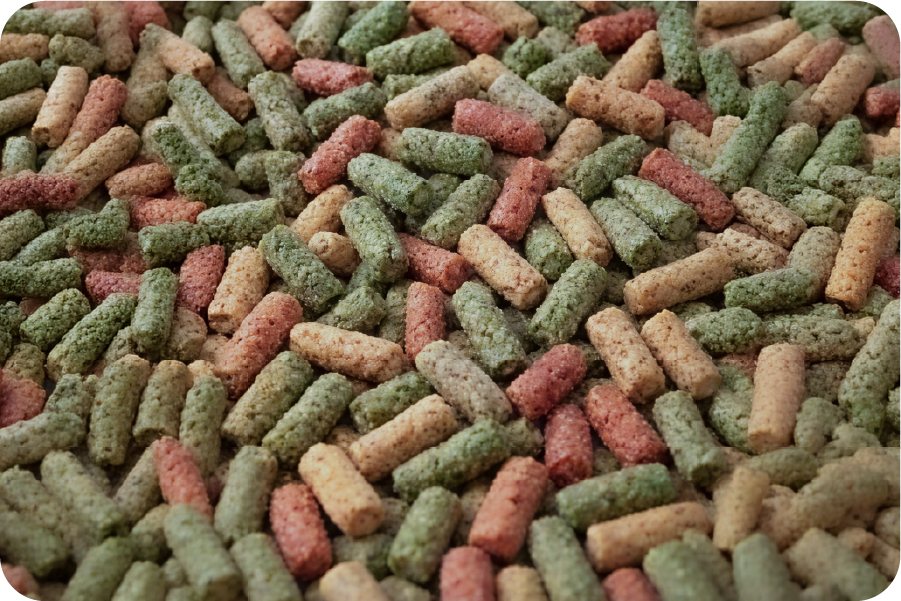
Choose a product in which each pellet has a similar appearance and composition.
If the package contains corn flakes, whole grains, seeds, nuts, dried fruit, or colorful pieces, rabbits can easily pick out only the sweeter, higher-calorie ingredients.
Products that resemble breakfast cereal are often referred to as muesli-style rabbit food.
A 17-month University of Edinburgh study involving 32 rabbits found that muesli-style diets were associated with smaller, lighter fecal pellets and more uneaten cecotropes. Rabbits that consumed more hay also produced a greater amount of fecal matter. Study summary
Simply containing many different pieces does not mean a product is more nutritionally complete.
Preventing selective eating is more important.
2. Look for Adequate Crude Fiber, but Do Not Focus Only on the Highest Number
Fiber is at the heart of a rabbit’s diet.
According to the general guidance in the Merck Veterinary Manual, rabbit pellets may contain approximately 15%–20% crude fiber. For commercial complete feeds, the RWAF recommends looking for a fiber content of approximately 20% or higher.
However, a crude fiber percentage does not mean that pellets can replace hay.
The guaranteed analysis provides the results of chemical testing, but it cannot fully describe fiber length, chewing time, or the physical form of the food.
Compressed pellets are quickly broken apart and cannot provide the same prolonged chewing and dental wear as hay.
Use the fiber percentage as an initial screening tool.
Then consider the ingredients, physical form of the pellets, and how much actual hay your rabbit eats.
3. Healthy Adult Rabbits Usually Do Not Need Excessively High Protein
More protein is not always better.
The RWAF recommends that commercial food for the average adult rabbit contain less than 15% protein.
Young rabbits, pregnant or nursing rabbits, underweight rabbits, and rabbits recovering from illness may have different nutritional needs. Adult-rabbit standards should not automatically be applied to them.
If an adult rabbit regularly consumes large amounts of high-protein, high-calorie pellets while eating very little hay, the rabbit may be more likely to gain excess weight or leave uneaten cecotropes.
In addition to checking the nutritional analysis, weigh your rabbit regularly and monitor whether the bottom remains clean, as well as the size and quantity of the fecal pellets.
4. Understand the Ingredients—Do Not Automatically Reject a Product Because It Contains Hay Meal
Many rabbit pellets are made by grinding Timothy hay, alfalfa, or other forage ingredients, adding vitamins and minerals, and then compressing the mixture into pellets.
✦ Are the types of hay and other ingredients clearly identified?
✦ Is the formula appropriate for the rabbit’s life stage?
✦ Does it contain large amounts of seeds, nuts, dried fruit, or sweet ingredients?
✦ Is the nutritional analysis complete?
✦ Is the product fresh and free from moisture damage or rancid odors?
Once we understand that hay powder is simply a finely ground ingredient, we can evaluate its different uses more objectively.
It may be included in a complete pellet formula, or it may be used on its own as a more straightforward forage-based supplemental food. The difference lies in the overall formula, physical form, and intended use—not simply in the words “hay powder.”
5. For Adult Rabbits, Prioritize Grass-Hay-Based Formulas
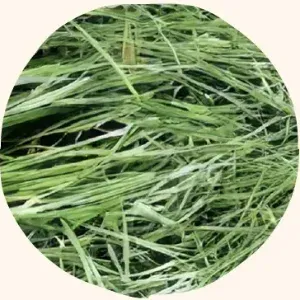
Timothy hay, orchard grass hay, and oat hay are grass hays that are generally suitable as everyday staple hays for healthy adult rabbits.
Alfalfa is a legume hay and is generally higher in protein, calories, and calcium. It is more commonly used for growing rabbits or rabbits with specific nutritional needs.
When choosing pellets for an adult rabbit, look for a grass-hay-based formula and confirm that the package clearly states that it is intended for adult rabbits.
Young rabbits, pregnant or nursing rabbits, senior rabbits, and rabbits with urinary, kidney, or dental problems should receive individualized guidance from a veterinarian experienced in rabbit care.
6. Check the Storage Condition and Observe How Your Rabbit Responds
Even the best formula is not suitable for feeding once it has become damp, moldy, or oxidized.
Before purchasing, check the expiration date and make sure the package is intact. After opening, keep the product sealed, protected from light, and stored away from moisture. Avoid buying more than you can use while it is fresh.
Do not replace the entire diet with a new pellet all at once.
Introduce it gradually into the existing diet while monitoring appetite, water intake, hay consumption, body weight, and droppings.
If your rabbit eats less, produces significantly smaller or fewer droppings, becomes lethargic, or develops abdominal bloating or pain, contact a veterinarian experienced in rabbit care as soon as possible instead of continuing to test the new food.
The RSPCA also recommends making all dietary changes gradually.
If the Package Says “Complete,” Why Can’t the Pellets Replace Hay?
“Complete” generally means that the product is formulated to provide a range of nutrients for its intended purpose. It does not mean that it can replace every function provided by eating hay.
A rabbit’s teeth grow continuously throughout life. Eating hay requires prolonged, repeated grinding motions that help support natural dental wear. A large amount of low-calorie fiber also allows rabbits to maintain a feeding and foraging rhythm that is closer to their natural behavior.
Pellets are concentrated, uniform, convenient, and easy to portion. However, because they are so easy to eat, rabbits can finish them very quickly.
If the pellet bowl is constantly refilled, hay may be ignored even when plenty is available.
✓ First observe how much hay your rabbit eats each day, and then adjust the amount of pellets.
✗ Fill the pellet bowl first and leave only a little remaining appetite for hay.
Beyond Pellets, Why Consider Hay Powder?
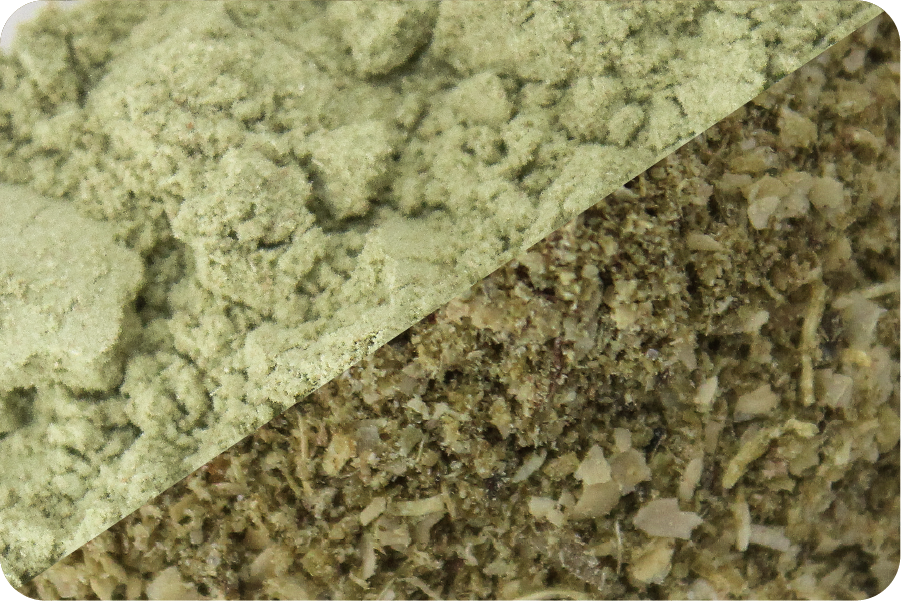
For rabbit owners who have always relied on conventional pellets, hay powder offers another option for daily supplementary feeding.
Pellets combine ingredients into a uniform formula.
Hay powder made with clearly identified whole-food ingredients lets owners choose based on the hay base, ingredients, and their rabbit’s nutritional needs.
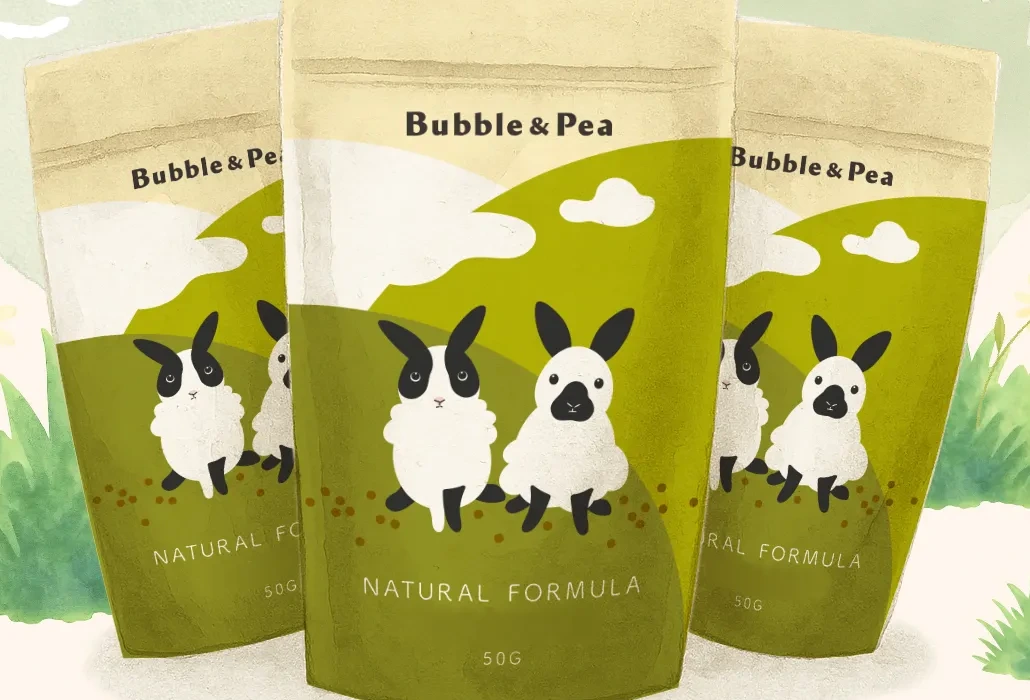
Bubble & Pea hay powder can be used as an alternative to conventional pellets. Adjust the transition pace to your rabbit’s response—rabbits that adapt well can transition more quickly, while others may need a gradual change. Monitor appetite, droppings, and body weight throughout the transition.
Long-strand hay should remain freely available at all times.
| Food | Primary Role in the Diet | What to Look For |
|---|---|---|
| Long-strand hay | The foundation of a rabbit’s daily diet | Fresh, dry, low in dust, free from moldy odors, and something your rabbit will eat consistently |
| Pellets | A small, measured source of concentrated nutrition | A hay-based formula with no grains, soy, or other fillers, and fiber, protein, and calcium levels suited to your rabbit’s life stage. |
| Single-ingredient or blended hay powder | A forage-based supplemental food that adds variety to the diet | A finely ground, hay-based formula with a variety of vegetables, fruits, herbs, and seeds to provide a broader range of nutrients than hay alone. |
If you’re interested in a more hay-centered feeding routine, you might like to try a finely ground hay powder made with hay, vegetables, fruits, herbs, and seeds.
See how your rabbit takes to it, follow the recommended serving amount, and adjust the transition pace to their response. Keep fresh long-strand hay freely available throughout.
Bubble & Pea’s hay powders to learn about each formula’s ingredients and nutritional benefits.
How to Introduce Hay Powder into Your Rabbit’s Diet
Start by checking the product’s ingredients, intended use, and feeding instructions. Some formulas are designed for daily nutritional support, while others are intended for recovery or assisted feeding. Their uses may overlap, but their formulations and feeding instructions can differ.
Follow the recommended serving amount and adjust the transition pace to your rabbit’s response.
Keep these three principles in mind:
1. Keep Long-Strand Hay Available at All Times
Even a high-fiber hay powder cannot provide the same chewing and foraging experience as long-strand hay.
2. Change One Food at a Time
Adjust one part of the diet at a time so you can more easily see how your rabbit responds.
3. Monitor Appetite and Droppings
Watch for changes in appetite, droppings, and behavior. If your rabbit stops eating, produces fewer droppings, or shows signs of abdominal discomfort, pause the diet change and contact a rabbit-experienced veterinarian promptly.
If dental pain is causing your rabbit to rely on powdered or softened foods, a veterinary examination and appropriate treatment are essential.
Softer foods can help support feeding, but identifying and addressing why your rabbit is avoiding hay remains the priority.
A Note from Bubble & Pea: Choosing Rabbit Food Is About More Than the Numbers
When choosing rabbit pellets, it is easy to be drawn to “high-fiber” or “natural” claims and attractive packaging.
Each type of food has a different role to play in a balanced daily diet:
| Long-strand hay provides the foundation for daily fiber intake and prolonged chewing | Pellets provide a measured source of concentrated nutrition |
|---|---|
| Hay powder offers another option for hay-based supplementary nutrition | Leafy greens and herbs contribute nutrients, variety, and moisture |
To learn more about the roles of hay, hay powder, and pellets, read:
Do Rabbits Have to Eat Pellets? How to Choose Between Hay, Hay Powder, and Pellets
This article provides general rabbit-care information and does not replace individualized veterinary advice, diagnosis, or treatment.
Young rabbits, pregnant or nursing rabbits, underweight rabbits, senior rabbits, and rabbits with health conditions have different nutritional needs. Consult a veterinarian experienced in rabbit care before changing their diet.
FAQ
Q What Should I Check First When Choosing Rabbit Pellets?
First, confirm that the product consists of uniform rabbit pellets rather than a mix containing cereal flakes, seeds, nuts, dried fruit, or colorful pieces.
Next, check the fiber and protein content, primary ingredients, and intended life stage.
Finally, remember that no matter how nutritionally complete the pellets claim to be, healthy rabbits still need access to hay at all times.
Q Is a Higher Crude Fiber Percentage Always Better?
Not necessarily. Crude fiber is an important factor to consider, but it is not the only one.
As a starting point, compare products with approximately 20% crude fiber or more. Also consider ingredient quality, food texture, other nutrient levels, and how much you feed.
Even high-fiber pellets cannot provide the same prolonged chewing activity as long-strand hay.
Q Does “Hay Meal” or “Timothy Hay Meal” Mean a Product Is Poor Quality?
Not necessarily.
Many rabbit pellets are made by grinding the ingredients before blending and pressing them into pellets.
Rather than judging a product by the word “meal” alone, look for a clearly identified hay source, adequate fiber, a formula suited to your rabbit’s life stage, and no unnecessary additives.
Q How Much Pellet Food Should a Healthy Adult Rabbit Eat Each Day?
Pellets should be offered in measured amounts.
The RWAF gives approximately 15 grams per kilogram of body weight per day as a feeding guideline. For example, this would be approximately 30 grams for a 2-kilogram adult rabbit.
Adjust the amount according to the pellets’ calorie content, your rabbit’s body condition, activity level, hay intake, and veterinary advice.
If your rabbit fills up on pellets and barely touches hay, reassess the portion size.
Q Can Hay Powder Replace Pellets?
It depends on the formula. Hay powders vary: some contain only ground hay, while others combine hay with vegetables, fruits, herbs, and seeds for additional nutritional support.
f you’re considering hay powder as an alternative to pellets, look at its nutritional profile and how it fits into your rabbit’s overall diet. Replacement amounts should follow the product’s feeding guidelines rather than a gram-for-gram swap.
Long-strand hay should remain freely available. Rabbits with special health or nutritional needs may require an individually planned diet with veterinary guidance.
Q Can Hay Powder Replace Long-Strand Hay?
No.
Hay powder provides hay-based fiber and nutrients, but it does not offer the same prolonged chewing and dental wear as long-strand hay.
Rabbits should always have unlimited access to long-strand hay. Hay powder is a supplementary food, not a replacement for it.
Q How Should I Introduce Hay Powder for the First Time?
Check the ingredients and whether the formula suits your rabbit’s age and nutritional needs. Follow the recommended serving amount and adjust the transition pace to your rabbit’s response.
Avoid introducing other new foods at the same time so you can more easily assess how your rabbit responds.
Monitor appetite, hay intake, droppings, and behavior. If you notice concerning changes, pause the diet change and consult a veterinarian experienced in rabbit care.
Q Should I Choose and Feed Pellets Differently for Young Rabbits?
The same ingredient-quality standards apply, but growing rabbits have different nutritional needs.
They may need more protein, calories, and minerals to support growth. Hay choices, pellet formulas, and feeding amounts may therefore differ from those recommended for healthy adult rabbits.
Do not automatically apply adult feeding limits to growing rabbits. Adjust the diet according to your rabbit’s age, weight, growth, and veterinary guidance.
References
Article Information
Content prepared by: Bubble & Pea
Last updated: August 16, 2026